
How APIs, AI, and Cloud Architecture Are Transforming Enterprise Connectivity
New York, United States - December 5, 2025 / Flowroute /
Unified communications is entering a new era where programmable APIs, artificial intelligence, and cloud-native infrastructure merge to redefine how businesses connect.
The global unified communications market is projected to reach $595 billion by 2032, driven by hybrid work adoption and digital transformation.
CPaaS platforms are becoming the backbone of enterprise connectivity, with 90% of global businesses expected to leverage these solutions by 2028.
AI-powered features, including intelligent call routing, sentiment analysis, and virtual assistants, are becoming table stakes for competitive communication platforms.
Developers who master SIP trunking, VoIP integration, and messaging APIs now hold the keys to building next-generation customer experiences.
If you're building communication capabilities into applications, understanding these trends is essential for making informed technology decisions.
The fragmented approach of managing separate voice, messaging, and video systems is giving way to integrated platforms that deliver seamless experiences across every channel. This shift is a direct response to changing customer expectations and workforce dynamics.
The global unified communications market is expected to grow from $136.2 billion in 2023 to $595.1 billion by 2032. This growth reflects a shift in how organizations approach connectivity. Legacy PBX systems and siloed communication tools are being replaced by programmable, cloud-native solutions that adapt to business needs in real time.
For developers and IT leaders, this evolution presents both opportunity and challenge. The winners understand how to build unified communications solutions that scale, integrate cleanly with existing systems, and deliver the reliability that mission-critical applications demand.
What Role Does CPaaS Play in Unified Communications Architecture?
Communications Platform as a Service has emerged as the essential layer connecting applications to telephony infrastructure. Rather than building voice, messaging, and video capabilities from scratch, developers can leverage CPaaS APIs to embed these features directly into their software with minimal code.
The CPaaS market is experiencing remarkable expansion. Short-term forecasts put the market at $45.3 billion by 2027, and longer term projections estimate a value of $121 billion by 2034. All reports suggest a compound annual growth rate exceeding 25%. This growth reflects the increasing demand for programmable communication tools that integrate with existing business workflows.
What Makes CPaaS Different from Traditional Telecom?
Traditional telecommunications required significant infrastructure investment, specialized expertise, and long procurement cycles. CPaaS flips this model entirely. Here's how the approaches compare:
Aspect | Traditional Telecom | CPaaS Approach |
Infrastructure | On-premises hardware, dedicated lines | Cloud-native, API-driven |
Scaling | Weeks to months, hardware dependent | Instant, code-based provisioning |
Integration | Complex, vendor-specific protocols | RESTful APIs, webhooks, SDKs |
Pricing | Fixed contracts, capacity-based | Usage-based, pay-as-you-go |
Development | Specialized telecom expertise required | Standard web development skills |

This architectural shift empowers developers to treat communication as a composable service layer. Need to add SMS notifications to your application? A few lines of code. Want to enable click-to-call functionality? Configure a webhook. The barrier to entry has dropped while the sophistication of available features has increased.
How Are Developers Building with CPaaS Today?
Modern CPaaS implementations surpass basic calling and texting. Developers are creating intelligent communication workflows that respond to context, adapt to user behavior, and integrate data from across the enterprise.
Common implementation patterns include integrating voice capabilities into CRM platforms for seamless customer interactions, building automated appointment reminder systems with two-way messaging, deploying multi-factor authentication using SMS or voice verification, creating masked calling solutions for marketplace and logistics applications, and developing AI-powered contact center solutions with real-time analytics.
The key differentiator for success is choosing platforms that offer clean APIs, comprehensive documentation, and the carrier-grade reliability that business-critical applications demand.
How Is SIP Trunking Transforming Voice Infrastructure?
Session Initiation Protocol trunking is the bridge between legacy voice systems and modern cloud communications. For organizations with existing PBX investments, SIP trunking provides a path to modernization without complete infrastructure replacement.
The global VoIP services market, which includes SIP trunking, was valued at $144.77 billion in 2024 and is projected to reach $326.27 billion by 2032. This growth is driven by organizations seeking to reduce telecommunications costs while gaining flexibility and resilience.

What Technical Advantages Does SIP Trunking Offer?
Unlike traditional PRI lines that limit concurrent calls to fixed channel counts, SIP trunking scales elastically based on actual usage. No more capacity planning headaches or paying for lines that sit idle. When traffic spikes occur, the infrastructure responds automatically.
Modern SIP API implementations offer developers programmatic control over voice infrastructure. You can provision numbers, configure routing rules, and access call detail records through clean RESTful interfaces.
For developers integrating VoIP capabilities, the technology has matured. Quality of Service mechanisms ensure voice packets receive priority treatment, codec support has expanded to optimize for various network conditions, and failover mechanisms provide the reliability that enterprise applications require.
What Impact Is AI Having on Unified Communications?
Artificial intelligence is reshaping every aspect of enterprise communications. According to Gartner research, 40% of enterprise applications will integrate task-specific AI agents by the end of 2026, compared to less than 5% in 2025. The unified communications space is at the forefront of this massive adoption.
Where Is AI Making the Biggest Impact?
AI integration in communication platforms manifests across several critical areas. Intelligent virtual assistants now handle routine customer inquiries, freeing human agents for complex interactions. Real-time transcription and sentiment analysis provide insights that were previously impossible to capture at scale.
Automated Call Routing: Machine learning algorithms analyze incoming calls and route them based on context, caller history, and agent availability.
Predictive Analytics: AI examines communication patterns to forecast capacity needs and identify potential issues before they impact service.
Natural Language Processing: Voice interfaces understand conversational queries and execute actions without rigid menu structures.
Fraud Detection: Pattern recognition identifies suspicious calling behavior and blocks potential toll fraud in real time.
Developers building on unified communications platforms should consider how AI features integrate with existing workflows and enhance rather than complicate user experiences.
How Are Messaging APIs Transforming Customer Engagement?
Text messaging has evolved from a simple notification channel into a sophisticated platform for conversational commerce and customer engagement. With high SMS open rates, messaging is one of the most effective ways to directly reach customers.
Modern messaging API implementations go far beyond basic send-and-receive functionality. Developers can build intelligent workflows that respond to customer messages, integrate with backend systems, and maintain conversation context across multiple interactions.
What Features Define Enterprise-Grade Messaging APIs?
The gap between consumer messaging apps and enterprise messaging APIs has closed. Today's business messaging platforms offer rich media support through MMS, two-way conversational capabilities, delivery receipts with detailed status information, and seamless integration with voice and video channels.
Feature | Business Value |
10DLC Registration Support | Ensures carrier compliance and delivery rates |
Toll-Free Messaging | Enables high-volume campaigns with recognizable numbers |
Webhook Callbacks | Real-time delivery status and response handling |
Message Queuing | Handles burst traffic without dropped messages |
MDR Access | Detailed analytics for optimization and troubleshooting |
For developers, selecting a messaging API provider that directly handles carrier relationships eliminates the complexity of dealing with aggregators and gray routes that can compromise deliverability.
What Should Developers Consider When Choosing Platforms?
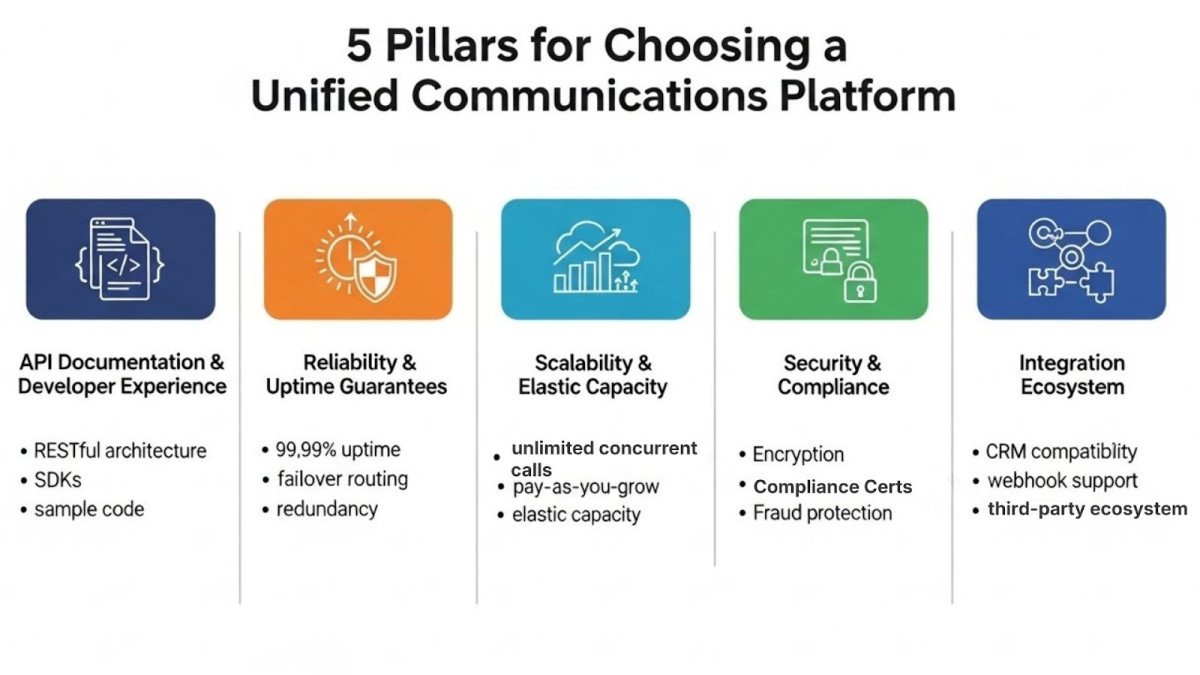
The proliferation of communication APIs means developers have more options than ever. Several factors should guide your evaluation when selecting platforms for applications.
Five Critical Evaluation Criteria
Reliability and Redundancy: Look for providers with documented uptime commitments and automatic failover capabilities. For voice applications, dynamic call routing that bypasses network impairments can mean the difference between business continuity and costly outages.
API Design and Documentation: Clean RESTful interfaces, comprehensive SDKs in your preferred languages, and thorough documentation accelerate development and reduce integration headaches.
Carrier Relationships: Providers who own their carrier connections rather than reselling through third parties typically offer better call quality, faster number provisioning, and more responsive support when issues arise.
Pricing Transparency: Usage-based pricing models allow you to start small and scale efficiently. Be wary of hidden fees, minimum commitments, or complex pricing tiers that obscure actual costs.
Support Quality: When voice or messaging systems fail, you need access to engineers who understand both your implementation and the underlying infrastructure. Evaluate support responsiveness and technical depth before committing.
What Does the Future Hold for Unified Communications?
The trajectory of unified communications points toward increasingly intelligent, integrated, and programmable systems. Several trends will shape the next evolution of this space.
5G networks are enabling new use cases that require low latency and high bandwidth. Video communication quality will improve, and edge computing will bring processing closer to end users. The convergence of IoT devices with communication platforms will create new interaction models that blend physical and digital experiences.
For developers, the opportunity lies in building applications that leverage these advancing capabilities while maintaining the reliability and security that enterprise users demand. The organizations that thrive will be those that recognize unified communications as foundational infrastructure rather than a bolt-on feature.
Frequently Asked Questions
What is the difference between unified communications and UCaaS? Unified communications refers to the integration of voice, video, messaging, and collaboration tools into a cohesive system. UCaaS (Unified Communications as a Service) delivers these capabilities through a cloud-based subscription model rather than on-premises hardware. UCaaS eliminates infrastructure maintenance and enables rapid scaling, making it the preferred deployment model for organizations embracing digital transformation.
How does SIP trunking reduce telecommunications costs? SIP trunking replaces traditional PRI lines with internet-based voice connections. Organizations typically save by eliminating hardware maintenance costs, paying only for actual usage rather than fixed channel capacity, consolidating voice and data onto a single network, and avoiding per-seat licensing fees common with legacy systems.
What programming languages work with communication APIs? Modern communication APIs use RESTful architecture, making them accessible from any programming language that can send HTTP requests. Most providers offer official SDKs for Python, Node.js, Ruby, PHP, and .NET. JSON request and response formats ensure compatibility with standard web development tools and frameworks.
How do I ensure message deliverability with SMS APIs? Deliverability depends on proper registration, carrier compliance, and choosing providers with direct carrier relationships. For business messaging in the United States, 10DLC registration is essential for long-code numbers. Working with providers who avoid gray routes and aggregators ensures your messages reach recipients reliably and don't trigger carrier filtering.
Start Building Future-Ready Communication Applications
Unified communications rewards those who move decisively while building on solid foundations. Whether you're enhancing an existing application with voice capabilities, modernizing legacy communication infrastructure, or crafting a new customer engagement platform, the technology choices you make today will determine your competitive position for years to come.
Flowroute delivers the programmable SIP trunking, messaging APIs, and carrier-grade reliability that developers need to build sophisticated communication applications.


Contact Information:
Flowroute
295 Madison Avenue
New York, NY 10017
United States
Paula Como Kauth
https://www.flowroute.com/



