Children's Hospital of Philadelphia Marks One-Year Anniversary of World's First Personalized CRISPR Gene Therapy for Child with Rare Genetic Disease
PR Newswire
PHILADELPHIA, Feb. 25, 2026
PHILADELPHIA, Feb. 25, 2026 /PRNewswire/ -- February 25, 2026 marks one year since KJ, an infant born with severe carbamoyl phosphate synthetase 1 (CPS1) deficiency, became the world's first person to receive a personalized CRISPR-based gene editing therapy. The therapy was developed by physician-scientists at Children's Hospital of Philadelphia (CHOP) and Penn Medicine, and in May 2025, CHOP shared that the treatment – created specifically for KJ's rare disease – was administered safely. Since that time, KJ has achieved meaningful clinical improvements, such as walking and talking, as he continues to grow and thrive.
"It's amazing to see KJ hit these milestones," said Rebecca Ahrens-Nicklas, MD, PhD, director of CHOP's Gene Therapy for Inherited Metabolic Disorders Frontier Program, which focuses on inborn errors of metabolism. "While this treatment isn't a cure, after three infusions from February through April 2025, KJ has tolerated it well with no serious side effects. He's able to handle more dietary protein, requires less nitrogen-scavenging medication, and we're seeing better control of ammonia levels during colds and similar childhood illnesses. He will continue to be monitored closely to track long-term outcomes."
A milestone born of decades of research and teamwork, CHOP has long integrated specialty clinical care with research to meet children's most urgent needs. KJ's personalized gene therapy, a base editor delivered via lipid nanoparticles to correct his CPS1 variant in the liver, evolved from years of preclinical work, collaboration between CHOP and Penn, and the NIH-funded Somatic Cell Genome Editing Consortium. Currently, CHOP supports more than 80 faculty advancing cell and gene therapy across more than 20 programs and 45 active pediatric clinical trials.
"We're just beginning to unlock gene editing's potential in pediatrics and beyond," said Kiran Musunuru, MD, PhD, MPH, ML, MRA, Co-Director of the Orphan Disease Center (ODC), a partnership between CHOP and Penn Medicine, who also co-led KJ's team with Dr. Ahrens-Nicklas. "We aim to responsibly develop and scale these approaches, so more children can lead healthy lives, and to invest in hands-on training so best practices reach all communities. We're also working on designing umbrella clinical trials that move us beyond one-patient treatments, accelerating access to scalable, adaptable therapies."
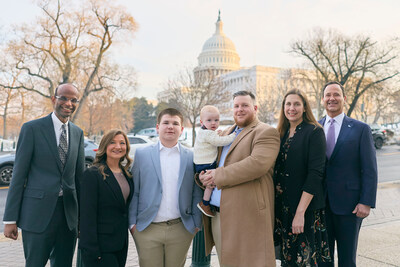
Earlier this month, the Muldoon's traveled with KJ to Washington, DC, alongside Ahrens-Nicklas and Musunuru, to share KJ's story with lawmakers. CHOP hosted educational briefing events in collaboration with the Rare Disease Congressional Caucus and the Personalized Medicine Caucus, highlighting the need for sustained federal funding for pediatric research and policies that expand access to personalized gene therapies.
"As KJ's parents, we want to put a human face on rare diseases," said Kyle Muldoon.
"Watching KJ grow and thrive is nothing short of a miracle – we want every child and family facing a rare condition to have that same chance," added Nicole Muldoon. "Lawmakers can make that possible by investing in research, expanding access to care, and ensuring innovative therapies reach patients now."
Looking ahead, CHOP researchers are pursuing causes and treatments for hard-to-treat metabolic disorders through CHOP's Gene Therapy for Inherited Metabolic Disorders (GTIMD) Program. They are studying conditions such as urea cycle disorders, organic acidemias, fatty acid oxidation defects, and phenylketonuria. KJ's case is also spurring discussions about new approval models for personalized therapies, and a New England Journal of Medicine editorial highlighted the lessons it offers the rare-disease community.
On Monday, February 23, Drs. Ahrens-Nicklas and Musunuru joined the FDA in announcing a new "plausible mechanism" framework for individualized therapies to speed approvals for rare diseases where large, randomized trials aren't possible. Under the pathway, all variant-specific versions of a gene editor would be treated as one drug, simplifying review. For example, a single trial could enroll people with any of seven urea cycle disorders (from seven different genes) that the same editor can fix, and positive results in as few as 5-10 patients, rather than hundreds, could be enough for FDA approval of the overall platform.
"We're committed to ensuring access for all children, and that means working together to develop a clear roadmap," said Ahrens-Nicklas. "Through full transparency in our science and regulatory interactions, we aim to empower more teams to develop safe, effective therapies and extend these advances across other pediatric rare diseases."
About Children's Hospital of Philadelphia:
A non-profit, charitable organization, Children's Hospital of Philadelphia was founded in 1855 as the nation's first pediatric hospital. Through its long-standing commitment to providing exceptional patient care, training new generations of pediatric healthcare professionals, and pioneering major research initiatives, the hospital has fostered many discoveries that have benefited children worldwide. Its pediatric research program is among the largest in the country. The institution has a well-established history of providing advanced pediatric care close to home through its CHOP Care Network, which includes more than 50 primary care practices, specialty care and surgical centers, urgent care centers, and community hospital alliances throughout Pennsylvania and New Jersey. CHOP also operates the Middleman Family Pavilion and its dedicated pediatric emergency department in King of Prussia, the Behavioral Health and Crisis Center (including a 24/7 Crisis Response Center) and the Center for Advanced Behavioral Healthcare, a mental health outpatient facility. Its unique family-centered care and public service programs have brought Children's Hospital of Philadelphia recognition as a leading advocate for children and adolescents. For more information, visit https://www.chop.edu.
Contact: Ashley Moore
Children's Hospital of Philadelphia
(267) 426-6067
moorea1@chop.edu

 View original content to download multimedia:https://www.prnewswire.com/news-releases/childrens-hospital-of-philadelphia-marks-one-year-anniversary-of-worlds-first-personalized-crispr-gene-therapy-for-child-with-rare-genetic-disease-302696376.html
SOURCE Children's Hospital of Philadelphia


